Hot Springs, SD Veterans AdministrationTo Care For Him Who Shall Have Borne the Battle,
And His Widow and His Orphan
President Abraham Lincoln
National Home for Disabled Volunteer Soldiers
•The local effort to build a National Home branch began in the 1890s.
•In 1898, the Grand Army of the Republic formed a committee to convince Congress to locate a National Home branch in Hot Springs.
•In 1902, Congress passed legislation authorizing the new facility.
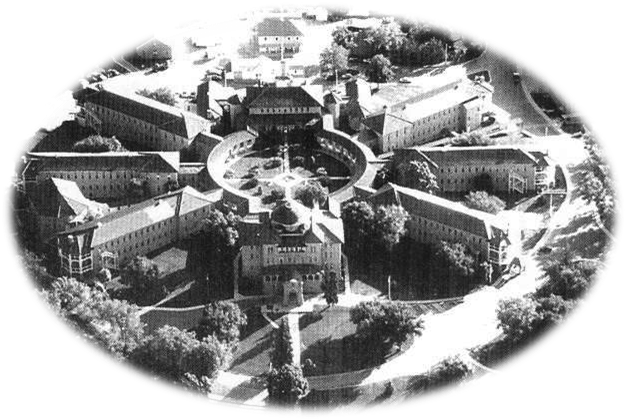
•The Battle Mountain Sanitarium opened in 1907 for its first patient.
Battle Mountain Sanitarium
•It was the first and only National Home for Disabled Volunteer Soldiers built solely as a short-term sanitarium for veterans with lung or respiratory problems.
•A majority of the buildings predate 1930, and many of them are still used for their original purposes.
Battle Mountain Cemetery
•The cemetery dates from 1907 .
•It became a national cemetery in 1973.
•The Battle Mountain Monument obelisk inscription reads ;
–“National Home, Disabled Volunteer Soldiers, Battle Mountain Sanitarium, 1914”
–“In Memory of the Men Who Offered Their Lives in the Defense of Their Country.”
•The cemetery is currently closed to additional internments.
Hot Springs Domiciliary
•The Hot Springs Domiciliary was one of the ten original facilities built in the United States.
•Upon its completion in 1907, it had the capability of housing 500 veterans.
•In the 1970’s, following closure of many psychiatric institutions throughout the United States, veterans were brought by bus to the Hot Springs Domiciliary from Knoxville, IA and St. Cloud, MN to live.
Hot Springs VA Hospital
•The increasing need for space led to construction of the Main Hospital in 1926 to the east of the original building complex.
•By the early 1980s, the hospital housed 265 active inpatient beds to serve the veterans’ needs.
•Today there are only 10 beds available for inpatient care.
•There is no intensive care unit available.
•The surgery program has been dismantled.
Merger With Ft. Meade
•The Hot Springs VA Medical Center was merged with the Ft. Meade VA Medical Center in 1995.
•Our questions should center on the veterans and the care they receive!
•We should be asking the veterans what they need to attend to their needs.
•Are the decisions being made today in the best interests of ALL the veterans we serve?
What we have heard from VA Management
•We are serving a decreasing population as the WW II vets are dying.
•The number of vets coming out of the military are not keeping pace with the veterans who are passing away.
•The needs of veterans today are different than those of our grandfathers. (More mental health services, more outpatient services, more home health.)
Dom Relocation
What was said
•better access to jobs
•transportation
•community services, etc.
Reality
1.Most of the jobs found for our compensated work therapy patients are in Hot Springs and Crazy Horse. There are limited job offerings from Rapid City businesses.
2.The VA has not determined where the new Dom would be located. It is unknown if it will be on a bus route.
3.It is not defined what community services would entail.
Questions for Veterans and Taxpayers
1.Bars - How many bars and drugs are available in Rapid City compared to Hot Springs? How is this better for the veteran?
2.Hospital - In Hot Springs the hospital is across the street from the Domiciliary. How much does it cost for an ambulance to take a patient across town in Rapid City? And how much will it cost to transport a patient from the State Vets Home in Hot Springs to Rapid City?
3.Cost - Strategic Capital Investment Planning Process Project Priority List for 2012 to Build a Domiciliary Replacement in Rapid City - $34,000,000
Millions of taxpayer dollars to replace a Dom we already have.
Black Hills Project Submissions for FY ‘12
•Two projects for Ft. Meade enhance their ability to perform surgery while surgery at Hot Springs is proposed for closure.
•The third project, renovate intensive care unit, allows them to do more than same day surgeries.
•ICU at Hot Springs was down graded some years ago limiting us to only same day surgery.
Future Construction Plans
•If you’re going to justify a 9.2 million dollar surgical tower the increase in patients has to come from somewhere, looks like Hot Springs.
•The projects for the Hot Springs hospital are to renovate “clinics”.
The focus of our current administrators is for Black Hills Health Care System to have it’s major presence represented in Ft. Meade and Rapid City. Veterans from Hot Springs and south will be expected to adapt to the change or seek their medical care elsewhere.
Hot Springs Surgery Department
•The Hot Springs Surgery Department has been systematically dismantled beginning in 1996.
•Many of our veterans from Nebraska and central South Dakota must now drive an additional 190 miles for outpatient procedures. (95 miles one-way)
•Some veterans refuse to drive the additional miles and put off surgery.
What is being done to provide surgical services?
•Upper management has said that nurses do not want to live or work in Hot Springs.
•Upper management has said that surgeons do not want to live or work in Hot Springs.
•Upper management has abolished the position for a surgeon in Hot Springs.
•Management has stated that limited surgical procedures will be provided with part time coverage.
Inpatient Services
•From a hospital that once had 6 wards with 260 patients, we now have 1 ward (1 East) with 10 inpatient beds.
•1 East also has 6 beds for hospice and nursing home care.
•This ward has been chronically understaffed for several years.
•If staff are not available to cover for sick calls, patients are diverted to other hospitals.
Ramifications of Diversion
•$23,483,675 of taxpayer money was spent on NON VA care by the Black Hills in FY 11
•Rapid City Regional Hospital is 11th in the nation for receiving VA funds for treating Veterans. ($11,346,112)
•This ranking is slightly lower than earlier this year when the ranking for RCR Hospital was 7th in the nation.
•This is money that could be used to hire staff to treat our veterans.
VA Handbook 7545 Cultural Resource Management Procedures
•This handbook introduces new procedures on how VA will meet Federal preservation requirements for all program and construction activities that have an effect on cultural or historic resources.
•This handbook contains mandatory Department of Veterans Affairs (VA) procedures for preparing, approving, and implementing VA Cultural Resource programs and documents.
Standards
a. Utilization of Historic Buildings
(1) Prior to acquiring, constructing, or leasing new buildings, VA shall use historic buildings under VA control to the maximum extent feasible.
(2) Full consideration is to be given to rehabilitating historic buildings under VA control to support VA's mission.
(3) Where rehabilitation alternatives are comparable to other alternatives, and where construction and long-term costs are not significantly greater, rehabilitation is encouraged.
b. Preservation of Cultural Resources
(1) VA shall consider and follow preservation standards and guidelines established by the Secretary of the Interior, for all construction and maintenance activities that may affect cultural resources.
(2) In meeting building and fire code standards consideration shall be given to the building's historic character and integrity.
In Summary
•Has anyone asked the veterans or their service organizations about these changes?
•How would the veterans be better served with the proposed changes?
•Would veterans be better served by providing the care they need in Hot Springs?
•Is it time for Hot Springs to have its own leadership?
•Is taxpayer money being spent on worthwhile projects?
Hot Springs VA Future
•We believe that the veterans who receive care at the Hot Springs VA should have a say about where and how they receive that care.
•Taxpayers should be informed about the costs associated with all of these proposed changes.
|